
SPINACH Growers Guide
Growers guide
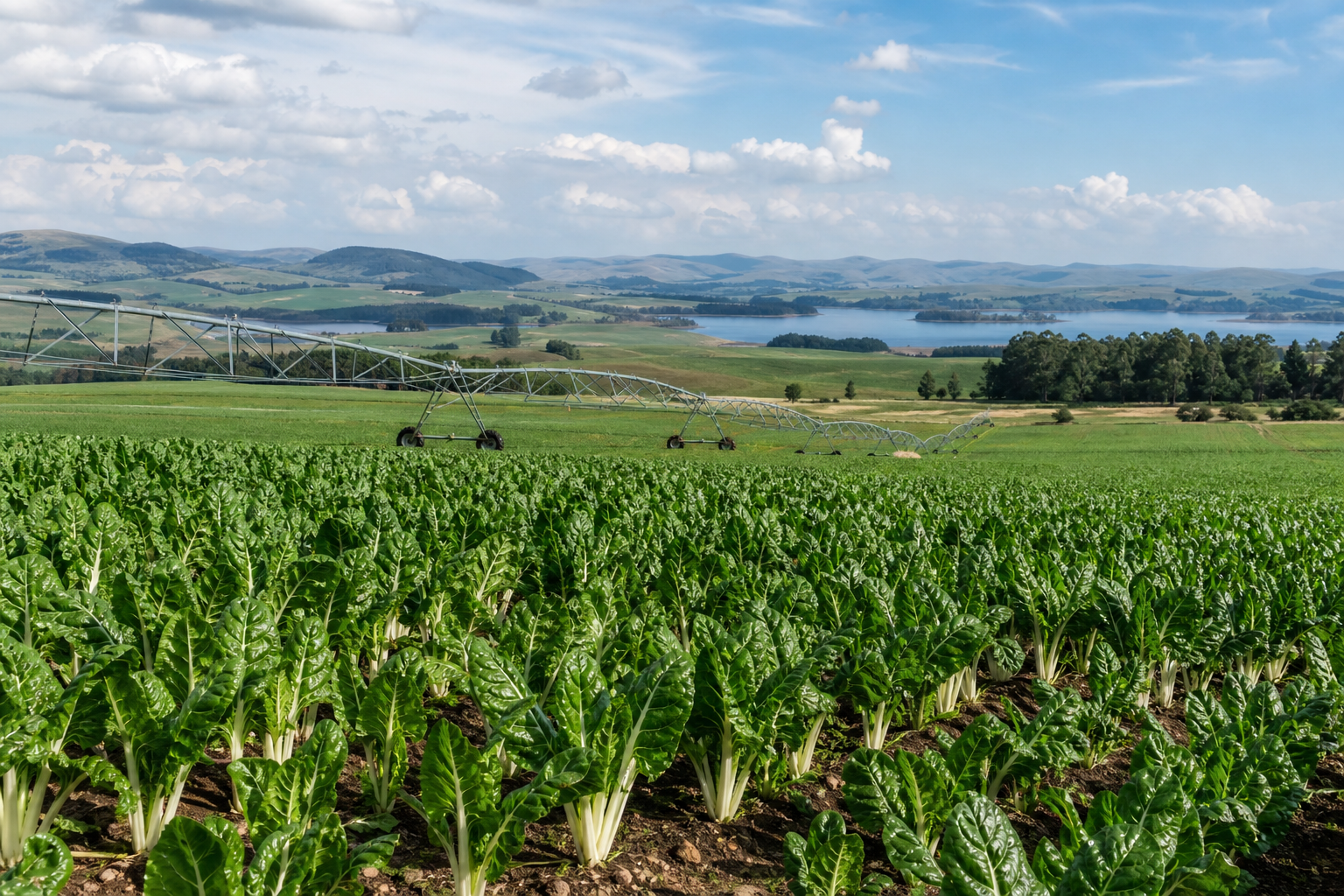
Spinach (Swiss chard in South Africa) is an excellent beginner’s crop. It regrows after harvesting, is cheaper to plant, and offers flexibility when markets are weak — if prices are low, you can leave the crop in the field and return later
-
Finance
Margins, break-even, and labor costs are critical when growing Swiss chard. Current margins are around R45 per bag, but rising labor and fuel prices mean this is close to break even. Labor is the biggest expense, especially for weeding and harvesting, though the actual growing process is not too costly.
If you plant from seed, your main costs are harvesting and delivery to market. Seed is cheap, but poor germination can leave fields patchy — you’ll still pay staff to weed, but won’t get enough product out. Planting in spring is attractive, but markets are often flooded due to ideal climate conditions that allow even weak crops to yield. This oversupply can push prices down, hurting margins. -
Soil
Soil testing is essential before planting spinach (Swiss chard).
- Sample costs range from R100–R500 depending on location.
- Crop establishment can cost up to R100,000 per hectare.
- Check pH and organic matter.
- Spinach tolerates pH as low as 4.3, but quality drops.
Aim for Ideal pH
Recommended range: 5.5–7.0.
- Swiss chard is highly sensitive to soil conditions.
- Avoid acid saturation.
- Apply lime to raise pH and supply calcium.
- Work lime into soil before planting.
- Chicken manure helps improve soil health over the long run.
Nutrient Needs
Swiss chard grows short and thick without proper nutrition, but the market prefers long stems.
- Calcium, potassium (K), and nitrogen (N) are essential for stem length and leaf quality.
Use MAP Fertilizer
High-acid soils -
Inputs
Fertilizer Program
Apply 600 kg/ha of 2:3:4 (30) at planting.
- At week 2, add 200 kg nitrogen.
- At week 5 (from transplant), apply 5:1:5 (40).
For direct-seeded crops:
- Top dress at week 4 with LAN.
- At week 7, apply 5:1:5 (40).
- Follow up with 100 kg LAN after each pick (approximately every 3 weeks).
Some growers have successfully picked for up to 9 months of the year.
Calcium and foliar feeds are important for stem length and plant health. Products like Bioforge and Bioage are effective on young plants, reducing transplant shock and making a noticeable difference in growth. -
Best growth practice
Spacing
Swiss chard can be planted fairly close if you follow a strong fertilizer program. Plant in 30 cm rows, with 3–5 rows per bed depending on tractor width. In the row, space plants about 17.5 cm apart. High populations help because many plants will be pulled out or damaged during repeated harvesting.
Cultivar Choice
Fordhook Giant is the standard cultivar. It produces large leaves and long stems, which consumers prefer even though the stems are not usually eaten.
Irrigation
Apply around 15 mm per week. Swiss chard grows well after rain and performs best in spring and autumn. It can produce in winter and summer, but each season brings different challenges.
Scouting & Pests
Armyworm is a common problem in autumn (Feb–Mar). Worms easily damage Swiss chard, so regular spraying is essential. Frequent scouting helps catch infestations early. Cercospora leaf spot is another risk in summer, requiring careful management. -
Major disease & pest
Pests & Diseases
Cercospora Leaf Spot
This disease is most common in summer and is very difficult to control once established.
- The best strategy is to spray preventatively from the seedling stage.
- Use fungicides such as Aroxy, Amistar Top, and Bravo.
- Maintain balanced nutrition, especially potassium (K), to strengthen plants.
- Spray weekly — once Cercospora is in the crop, it does not leave.
- In severe cases, the only option is to slash the block and allow it to regrow, or replant entirely.
Other Pests
Armyworm is a recurring problem in autumn (Feb–Mar). Worms easily damage Swiss chard, so regular spraying and scouting are essential. -
Harvesting
Packaging
Swiss chard is packed in a green lug liner and wrapped with a No.32 elastic band.
- Each bag contains 10 bunches.
- A Fresh mark bunch is cut short and weighed 600g.
- The open market prefers 1 kg bunches, so each bag should weigh 10 kg — this ensures customers cannot complain about underweight bags.
Labour & Transport
Labour and transport are the main costs in Swiss chard production.
- A good pick can yield 400–600 bags per hectare.
- In clean fields, 30 staff can pull 900 bags in a day.
- To achieve this, all steps in the guide must be followed carefully.
Labour Planning
- About 12 labor units per hectare are recommended.
- One week for weeding, one week for harvesting, one week off working a 5‑day week.
- Patchy fields make it hard to profit, as labor costs remain but yields drop.
Market Prices
- Prices are high most of the year, except in spring when oversupply pushes prices down to around R20/bag.
- In high‑demand summer months, prices can rise to R180/bag. you can set up a ping on our market watch to message you when Spinach is high. -
Markets
Marketing & Sales
Retail
Retailers buy large volumes of Swiss chard, making them a key outlet. Supplying local retail stores with a fresh pick once or twice a week is a strong opportunity.
Restaurants
Restaurants drive demand in summer, often pushing prices higher. Consistent quality and supply are essential to capture this market.
Street Vendors & Hawkers
Hawkers and street vendors purchase significant quantities, moving product quickly into communities. They are a reliable channel for steady sales.
Processors & Traders
Processors and traders also buy in bulk, providing additional outlets beyond fresh retail and markets.
Fresh Produce Markets
The fresh produce markets move a lot of spinach. We recommend Port Natal in Durban as a strong market option — Shamilla is a trusted buyer who will never let you down. -
Planting windows by region
Climate & Regional Suitability
Coastal Areas
Swiss chard does well in winter near the coast, especially close to population centers. However, it struggles in the high humidity of summer.
Lowveld
Performs fairly well year-round, though summer is a challenge. Prices often compensate for the difficulty of production in this season.
Highveld
Best suited for summer production. Winter is slow due to high altitude and cold conditions, making it less profitable.
Irrigation
Not recommended without irrigation, though it is possible. Swiss chard grows well in autumn and spring, with spring being the best growth period. In summer, growth is fast, but leaves die quickly if stressed.
Harvest Timing
In summer, avoid picking during the heat of the day. Harvest early in the morning or later in the afternoon (around 3–4 pm) to maintain quality.
Informational only — not agronomic advice. Confirm rates, chemicals, and programmes with your local rep and product labels before use.